 By Admin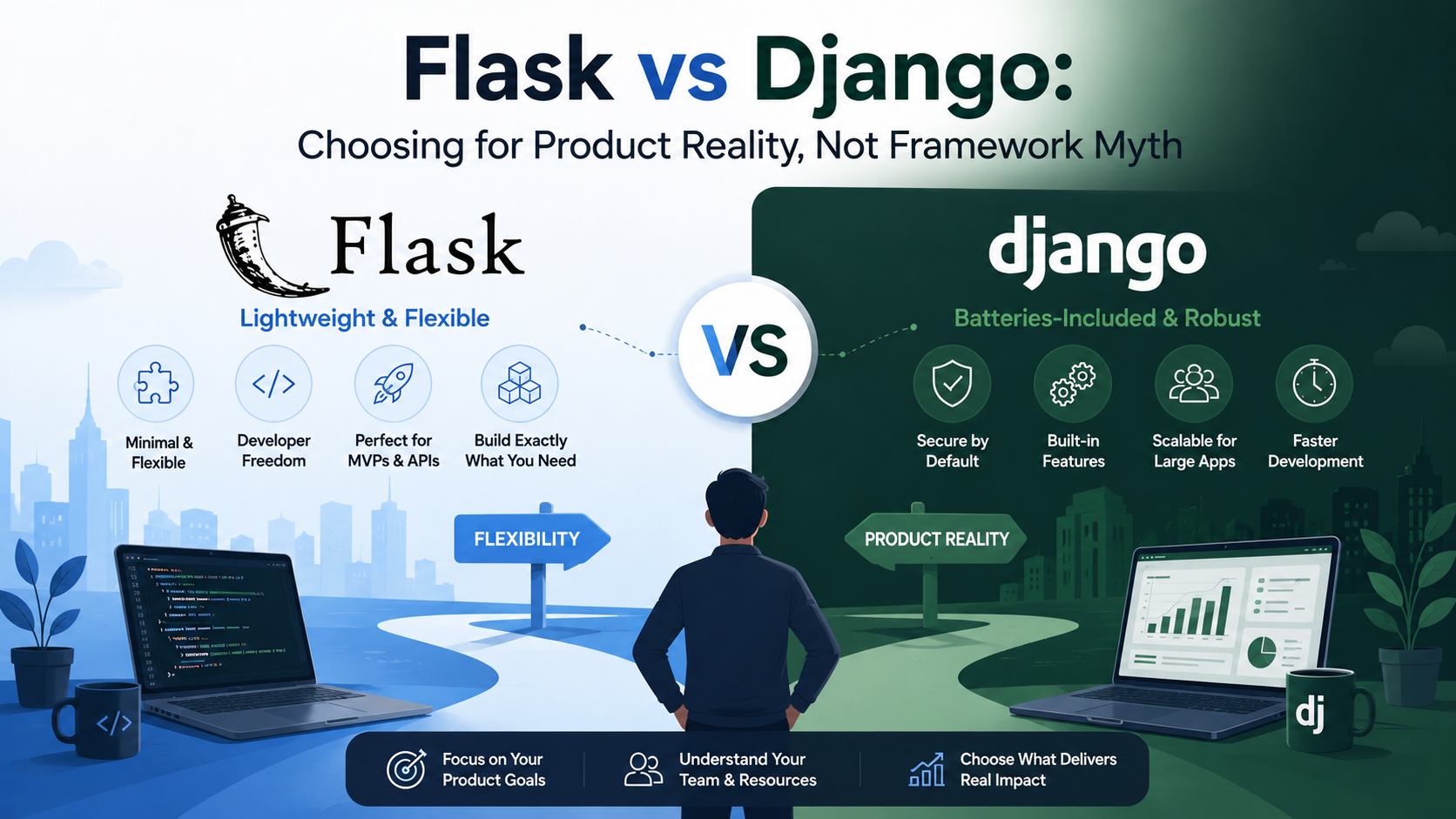
The Flask vs Django debate is often flattened into a tired contrast between minimalism and built-in features. That misses the real question. For serious B2B teams, the decision is rarely about which framework looks cleaner in a tutorial. It is about how much architectural freedom a product needs, how quickly requirements are shifting, and whether the team wants conventions supplied upfront or assembled with intent.
That distinction matters because business applications do not stay still for long. A sales operations platform begins as a dashboard and turns into a workflow engine. A partner portal acquires layered permissions, approvals, and reporting. An internal tool that started small suddenly becomes mission-critical. In those environments, the framework decision shapes not only delivery speed, but also how gracefully the product absorbs change.
Where Django Wins Fairly
Django earns its reputation for a reason. It gives teams a substantial amount of working infrastructure from day one: ORM, admin, authentication patterns, stronger defaults, and a development model that reduces guesswork. If the product has predictable requirements and a fairly standard web shape, Django can compress delivery time in a meaningful way.
That advantage becomes especially clear in applications with dense CRUD behavior, well-defined user roles, admin-heavy operations, and a data model that sits at the center of the product. In those cases, built-in structure is not overhead. It is leverage. Teams spend less time deciding how to assemble the stack and more time shipping features inside a known pattern.
Why Flask Keeps Showing Up in Serious Products
Flask is often described as lightweight, but that word is too small for what makes it commercially useful. Its real strength lies in selective architecture. It lets teams decide where complexity should live instead of assuming complexity belongs inside the framework. That becomes valuable when the product is integration-heavy, workflow-specific, or still discovering its final shape.
Consider a backend that has to orchestrate pricing rules, approval logic, third-party data flows, and a custom interface for operations teams. That is not unusual in enterprise software. In that situation, Flask can feel less like a stripped-down option and more like a disciplined way to avoid dragging in machinery the product does not need. The flexibility is not decorative. It changes how cleanly the system can evolve.
This is where the Flask vs Django comparison gets interesting. Django reduces local decisions. Flask preserves them. Neither is automatically superior. The question is whether your product benefits more from inherited structure or deliberate composition.
Performance Is Usually a Design Story
One of the weaker habits in framework writing is treating performance as a trophy. Flask is lean, and yes, it can feel fast. Django carries more framework weight, and yes, that can affect how quickly a project feels opinionated. But in production systems, performance is rarely decided by framework branding alone. Query strategy, caching, worker configuration, background processing, and deployment design usually matter more.
That is why experienced teams do not choose Flask simply because they assume it wins benchmarks. They choose it when they want tighter control over how the backend is assembled, tuned, and extended.
APIs, Internal Platforms, and the Cost of Freedom
Flask becomes especially attractive when a product is really a service layer dressed as a web application. Internal platforms, partner APIs, orchestration panels, modular backends, and custom portals all benefit from that kind of flexibility. It is also a practical fit for teams building web layers around analytics systems or artificial intelligence services, where the backend needs to expose inference endpoints, model review flows, or operational dashboards without becoming a full-stack monolith.
Still, freedom has a cost. Flask does not save teams from architectural inconsistency. It asks them to earn consistency themselves. Security patterns, project layout, testing discipline, extension choices, and deployment standards need to be defined and maintained. A strong engineering team can turn that freedom into a strategic asset. A careless one can turn it into fragmentation.
That is why choosing a capable Flask app development company matters when the business is betting on a custom backend that will need to grow without becoming brittle.
The Better Decision Rule
The best way to think about Flask vs Django is not size, popularity, or trend. It is product condition.
- Choose Django when the application is structurally familiar, the workflows are stable, and built-in tooling will accelerate delivery more than it will constrain it.
- Choose Flask when requirements are still moving, integrations are central, workflows are business-specific, and architectural control will pay back over time.
That is the position we take at Pattem Digital when businesses assess Python frameworks for serious digital products. We help organizations choose between Flask and Django based on product structure, integration needs, scalability goals, and long-term maintainability rather than broad framework preferences. For teams building custom backends, modular platforms, API ecosystems, or modern web applications, Pattem Digital brings the engineering depth needed to turn that choice into a durable product foundation.